Tests Required to Renew Your NC Driver License
Renewing a driver license can be confusing when it is unclear whether you need a vision screening, written exam, or road test. For most drivers, renewal does not mean retaking every test. The right answer depends on how you renew, whether your license is expired, and whether NCDMV needs to address a safety or eligibility concern.
Which tests may be required at renewal?
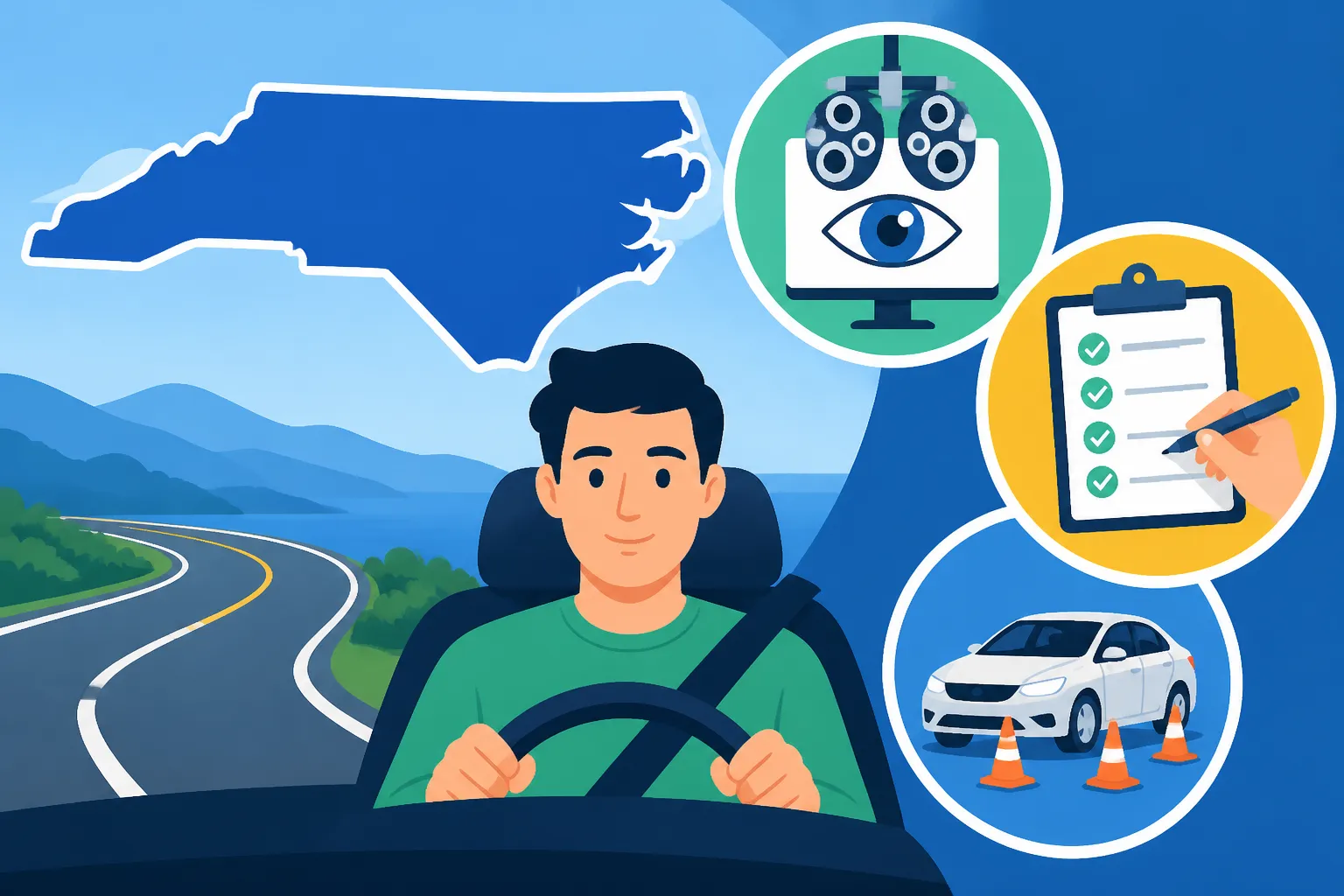
The main test drivers may encounter during a North Carolina license renewal is a vision screening. A knowledge test or road test is not automatically required at every routine renewal, but NCDMV may require one in particular circumstances.
| Test | What it checks | When it may come up |
|---|---|---|
| Vision screening | Whether you can see well enough to drive safely, with any required correction | Commonly part of an in-person renewal |
| Knowledge test | Understanding of traffic laws, signs, and safe driving rules | When NCDMV requires a knowledge retest, such as in certain renewal or safety situations |
| Road test | Ability to control a vehicle and follow traffic rules while driving | When NCDMV determines an on-road evaluation is needed |
These are different assessments, and a requirement for one does not automatically mean you must take the others. A vision screening, for example, is not a written test. It checks visual ability and may result in a restriction requiring corrective lenses or other follow-up.
The exact steps can depend on your record, credential status, renewal method, and individual circumstances. Check the instructions for your renewal with NCDMV before making plans, especially if your license has been expired, you have a medical concern, or you have been told that a test is required.
For a broader overview of possible renewal steps, see Guide to Driver License Renewals in North Carolina. If you want to understand which assessments may apply in more detail, When NCDMV Requires Testing for License Renewal covers the situations that can trigger testing.
Vision screening and renewal
What a vision screening involves
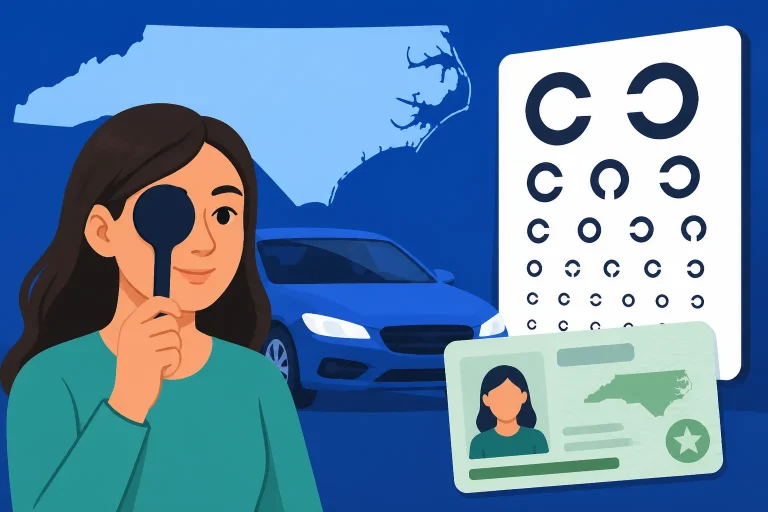
A vision screening checks whether your eyesight meets the standards for driving. At an in-person renewal, expect to follow the examiner’s directions for a basic visual assessment. If you normally use glasses or contact lenses to drive, bring and wear them. A screening result may determine whether your renewed license carries a corrective-lenses restriction.
The screening is not the same as a full eye examination. If you have concerns about your eyesight, or have recently noticed changes that could affect driving, arrange an examination with an eye-care professional rather than relying on a renewal screening to diagnose a problem.
NCDMV may have a process for drivers whose screening result needs additional review. If you cannot meet the screening requirement at the counter, ask what documentation or next steps are accepted in your situation. Do not assume that an outside eye exam automatically replaces a screening or that a particular form will be accepted without checking first.
If you wear glasses or contacts
Bring the corrective lenses you use for driving, even if you usually wear contacts and have glasses as a backup. If your license already requires corrective lenses, driving without the required correction can violate that restriction. A renewal is a good time to make sure the restriction still reflects what you need to drive safely.
A screening may also lead to a new or updated restriction. If that happens, read the renewed credential information carefully and follow the restriction whenever you drive. For more on how these conditions work, see Corrective Lenses Restrictions on North Carolina Licenses and How Corrective Lenses Impact Your NC License Renewal.
If a vision problem has recently developed, do not wait for a renewal appointment to decide whether you are safe to drive. Get medical advice about your specific vision and follow any driving guidance you receive. NCDMV handles license requirements; an eye-care professional can assess your eyesight.
Online renewals and vision testing
Renewing online is different from appearing at a driver license office. Some online renewals may not involve an in-person vision screening, but that does not mean every driver is eligible to renew online or that testing requirements are waived in all circumstances.
Online eligibility can depend on factors such as the credential, renewal history, and restrictions on the license. If the online service does not allow you to proceed, do not try to work around the result. Check the reason and determine whether you need to renew in person or address another issue first. Online Renewal Restrictions for Corrective Lenses and Code 24 in NC explains one set of restrictions that may affect online renewal.
Before choosing a renewal method, review Renewing Your North Carolina Driver License Online and confirm your eligibility directly with NCDMV. If your renewal requires an in-person visit, NC License Renewal Vision Test Requirements and Vision Screenings for NC In-Person Renewals provide related information about the screening process.
When a knowledge test may be required
A knowledge test checks your understanding of road rules, signs, and safe driving practices. It is not a standard requirement for every driver at every renewal. NCDMV may require a knowledge test when a specific issue makes it necessary to reassess the driver’s knowledge or eligibility.
An expired license is one reason to check carefully before assuming you can complete a routine renewal. The length of time since expiration can affect what steps are available, and a long-expired license may involve requirements that differ from an on-time renewal. The applicable requirement should be confirmed with NCDMV rather than guessed from another driver’s experience.
Other circumstances may also lead to testing, such as a review related to driving safety, a medical concern, or a licensing action. If you have received a notice from NCDMV, use that notice as your starting point. It may identify the test or other action required. If it is unclear, contact NCDMV or ask at the official office before taking a test-preparation course or booking an appointment.
A knowledge test is also distinct from the tests involved in getting a first license. If a retest is required, ask whether you need to take a signs test as well as a general knowledge test, and whether you need an appointment. Requirements may differ according to the reason for testing.
How to prepare if you are told to retake the test
Start with current North Carolina driving materials and the exact instructions NCDMV gives you. Review road signs, right-of-way rules, speed and lane rules, and other topics relevant to safe driving. Do not rely only on old notes, practice questions from an unknown source, or information meant for another state.
A practical preparation routine is:
- Confirm which test NCDMV requires and whether there are separate components.
- Review current North Carolina driver education or handbook materials.
- Make a list of rules or signs you are unsure about and revisit them.
- Use practice questions as a study aid, not as a substitute for understanding the rules.
- Check the appointment and identification requirements with NCDMV before going.
If you want additional structured practice, a course or study resource such as I Drive Safely may help you review general driving concepts. Treat any third-party material as supplementary, and use current North Carolina materials as the authority for state rules.
If you fail a required knowledge test, ask NCDMV what happens next and when you may retest. Do not assume the retest schedule or the number of attempts is the same for every situation. The process for a test required during renewal may differ from the process for a first-time applicant. For information about tests in general, see North Carolina Driver License Testing: Written, Signs, and Road.
When a road test may be required
A road test evaluates driving in a vehicle, including how a driver controls the car and responds to traffic situations. It is not a routine step for every license renewal. NCDMV may require an on-road assessment if it needs more information about a driver’s ability to operate a vehicle safely.
A road test may be considered as part of a review involving a medical or functional concern, a driving-safety issue, or another circumstance that calls for an individual assessment. The test requirement is specific to the driver’s case; having a medical condition does not, by itself, tell you whether NCDMV will require a road test. Follow any instructions in a notice or provided by the examiner.
If you are told to take a road test, ask what vehicle requirements apply, whether you need to schedule it, and what documents to bring. The vehicle may need to meet applicable safety and registration requirements. Do not arrive assuming that a normal renewal appointment also includes a road test; confirm that the correct appointment and test arrangements are in place.
Preparation should focus on safe, lawful driving rather than memorizing a short list of maneuvers. Review the basics: stopping smoothly, checking mirrors, using signals, choosing a safe lane, yielding appropriately, and observing signs and traffic controls. You can use Behind the Wheel: Complete North Carolina Road Test Checklist and Preparing for the North Carolina DMV Adult Road Test for general test-preparation information, while following the specific directions from NCDMV.
If you are worried that a physical or medical change could affect your driving, talk with a qualified health professional and follow NCDMV’s instructions. Do not drive if you cannot safely operate the vehicle while waiting for an assessment or decision.
Planning your renewal and avoiding surprises
Before you begin, identify whether your renewal is routine or whether something about your license needs attention. That distinction helps you avoid preparing for tests you do not need while still leaving enough time to complete any required assessment.
Use this checklist:
- Check the expiration date and whether the license is already expired.
- Confirm whether you can renew online or need an in-person visit.
- Read any notice from NCDMV and make a note of every test or document it mentions.
- Bring corrective lenses if you use them to drive.
- Ask NCDMV whether a separate test appointment is needed.
- Confirm current document and appointment requirements before traveling.
- If your license has a restriction, suspension, or other unresolved issue, clarify how it affects renewal before assuming you can renew normally.
If you need to renew in person, use NCDMV’s official office locator to find an office and check its current hours. Driver license services may be handled at different locations from vehicle registration or plate services, so confirm that the location offers the service you need. What to Bring to Your North Carolina DMV License Appointment can help you organize your visit.
A required test can affect your timeline. Leave room for scheduling, studying, addressing a vision concern, or resolving an eligibility issue. If you are unsure whether a test is required, verify before your appointment rather than counting on an examiner to fit an unexpected test into a routine renewal visit.
Also keep testing separate from other renewal requirements. A test does not resolve a suspension, unpaid obligation, or documentation problem. If you suspect a block on your license, check it before renewal; Finding Out if Your North Carolina License Is Suspended explains how to approach that question. If the issue involves restoring driving privileges, see Guide to License Suspensions and Restorations in North Carolina.
Frequently Asked Questions
Do all North Carolina drivers have to take a road test when renewing?
No. A road test is not a routine requirement for every renewal. NCDMV may require one in particular circumstances, so follow any case-specific instructions you receive.
Is a vision screening part of every renewal?
An in-person renewal commonly includes a vision screening. The process may differ for online renewals, and online eligibility does not guarantee that every driver can renew that way. Confirm your requirements with NCDMV.
Do I need a written test if my license has expired?
Not necessarily. The time since expiration and your circumstances can affect what steps are required. Check with NCDMV before assuming that a standard renewal or a particular test applies.
What should I bring if I wear glasses or contacts?
Bring the corrective lenses you use for driving and wear them during the screening. If you have a vision concern or have been asked to provide additional documentation, confirm with NCDMV what it accepts.
Disclaimer
This article is for general informational purposes only and does not constitute professional advice. Laws, prices and regulations vary by location and change over time. Consult a qualified professional for guidance on your specific situation. North Carolina Driver Guide is not a government agency and is not affiliated with any state motor vehicle department.