How to Get a Commercial Driver License in North Carolina
Getting a commercial driver license in North Carolina involves more than passing a written test. You need to choose the right license class, meet age and medical requirements, complete any required training, and pass the tests for the vehicles and endorsements you want. This guide explains the sequence, what to prepare, and where applicants commonly lose time.
What a North Carolina CDL Allows You to Drive
A commercial driver license, or CDL, is required for certain vehicles used in commercial driving. The license class depends mainly on the vehicle’s weight and whether it is a combination vehicle. Endorsements add permission to operate particular types of vehicles or carry certain passengers or materials.
The vehicle’s weight rating—not just how heavy it happens to be on a particular trip—often determines which class applies. A vehicle’s intended use and configuration matter too. If you are unsure which class covers a specific truck or bus, confirm the vehicle’s ratings and configuration before choosing tests or training.
| License or endorsement | What it generally covers |
|---|---|
| Class A | A combination vehicle with a gross combination weight rating of 26,001 pounds or more, when the towed vehicle has a gross vehicle weight rating over 10,000 pounds |
| Class B | A single vehicle with a gross vehicle weight rating of 26,001 pounds or more, or a qualifying vehicle towing a vehicle rated at 10,000 pounds or less |
| Class C | A commercial vehicle that does not meet the Class A or B definitions but is designed to carry 16 or more people, including the driver, or is used to transport placarded hazardous materials |
| T | Doubles or triples |
| N | Tank vehicles |
| H | Hazardous materials |
| X | A combination of tank and hazardous materials permissions |
| P | Passenger vehicles |
| S | School buses |
These descriptions are a starting point, not a substitute for checking the exact vehicle. For example, a truck that looks like a heavy-duty pickup may or may not meet the CDL definition, depending on its ratings and use. To sort out a particular noncommercial vehicle, see Is a North Carolina Class A License Always a CDL?. For the commercial class definitions, consider both the vehicle you will drive and the work you expect to do.
Choosing a class
Start with the job’s vehicle rather than the job title. Ask the employer or fleet operator for the vehicle’s gross vehicle weight rating and, for a combination, its gross combination weight rating and the rating of the towed unit. Those details can help you decide whether to pursue Class A, B, or C.
A Class A CDL may cover a range of combination vehicles, but it does not automatically include every endorsement or remove every restriction. A Class B CDL is generally aimed at qualifying single vehicles, such as certain large trucks and buses. A Class C CDL applies to specific commercial vehicles that fall outside the A and B definitions but meet passenger-capacity or hazardous-material criteria.
Getting a higher class than your work requires may involve extra training and testing. Getting a lower class—or missing an endorsement—can prevent you from operating the vehicle or doing the work you planned. Confirm the requirements for the actual vehicle before paying for instruction or booking tests.
Choosing endorsements
An endorsement is added to a CDL when the driver needs permission for a particular vehicle type or cargo. It is not a substitute for the correct base license class. A passenger endorsement, for example, does not make a Class C license sufficient for a bus that requires Class B.
Some endorsements involve extra knowledge tests, skills testing, security steps, or training requirements. Hazardous-materials permissions involve additional eligibility checks, so allow time for those separate steps. The requirements differ by endorsement; review North Carolina CDL Endorsements: Passenger, Tanker, and Hazmat before deciding which tests to take.
Check Eligibility Before Starting
Before studying or enrolling in a course, check that you meet the basic eligibility requirements for the kind of commercial driving you want to do. Age, driving location, license status, medical qualification, and the vehicle type can all affect the path.
Age and driving area
The minimum age depends on whether you plan to drive only within North Carolina or cross state lines. Federal rules generally require drivers to be at least 21 for interstate commercial driving. A driver who is 18, 19, or 20 may be eligible for certain intrastate commercial driving, subject to applicable North Carolina requirements and restrictions.
“Interstate” can be broader than simply crossing a state border during a trip. Some work can be considered interstate commerce even when the vehicle remains within one state. Ask the employer what type of operation the job involves, then confirm the applicable rules with the North Carolina Division of Motor Vehicles (NCDMV) before applying. Do not assume that an intrastate license path will qualify you for an interstate position later.
Existing license and driving record
You will generally need to hold the appropriate regular driver license before moving through the CDL process. If you have an out-of-state license, a suspended license, or an unresolved driving record issue, clarify your status first. An existing credential or a driving-related block can affect whether you can apply, test, or receive a CDL.
A CDL is not a way around a suspension or disqualification. If your driving privileges are uncertain, check your status with the NCDMV before paying for training. For background on the agency’s process for commercial credentials, see How State-to-State Verification Treats NC Commercial Licenses.
Medical qualification and self-certification
Commercial drivers may need to meet physical qualification standards. The medical paperwork required depends on the type of commercial operation you intend to perform. Applicants also need to select the correct operating category when they self-certify, such as interstate or intrastate driving and whether an applicable medical qualification exception applies.
If you need a medical examiner’s certificate, make sure it is current and that you understand how the information must be provided to the NCDMV. A certificate that has expired or has not been recorded as required may cause problems with CDL status. Do not wait until a job start date to find out that your medical records need updating.
If you are unsure which category describes your work, ask the employer and confirm with the NCDMV. Selecting the wrong category can affect whether you are qualified to drive the vehicle and the type of work you may perform.
Identity and residency documents
The agency may need to verify identity, Social Security information, and North Carolina residency. The exact document requirements depend on your circumstances and the service you are requesting. Prepare original or otherwise accepted documents as directed by the NCDMV; do not assume a photo or an expired document will be accepted.
A useful preparation step is reviewing the general North Carolina Driver License Checklist: Identity, SSN, and Residency. Commercial applicants should also confirm whether any additional paperwork applies to their license class, endorsements, or medical status. If a name on a document differs from the name on another record, resolve what supporting documents are needed before going to the office.
Get a Commercial Learner Permit and Complete Required Training
Most applicants need a commercial learner permit (CLP) before taking a CDL skills test. The CLP is a practice credential, not permission to drive a commercial vehicle alone. It gives an eligible applicant a supervised way to gain experience in the vehicle associated with the CDL they are pursuing.
Apply for the CLP
The first stage is generally to apply through the NCDMV, take the applicable knowledge tests, and meet the agency’s document and qualification requirements. Which tests you need depends on the class and endorsements you are seeking. General knowledge is commonly part of the process, while combination-vehicle, air-brake, and endorsement tests may apply to a particular application.
Check the current NCDMV instructions before selecting a service or traveling to an office. A driver license office handles driver licensing matters; a license plate agency handles vehicle and plate services. They are not interchangeable. For a closer look at what the written exams cover, see Commercial Driver Knowledge and Endorsement Testing in NC and Taking the North Carolina CDL Written Knowledge Exam.
Once issued, the CLP comes with conditions. You must follow its supervision and vehicle restrictions, and you cannot use it as an unrestricted CDL. In general, a qualified CDL holder must accompany and supervise you in the appropriate vehicle. A CLP also does not authorize every type of operation: for example, passenger or hazardous-material driving may have additional limits.
A federal minimum waiting period applies before a CLP holder can take the CDL skills test. Confirm the current requirements and permit validity with the NCDMV, especially if a test appointment is delayed or the permit is nearing expiration.
Complete entry-level driver training when required
Federal entry-level driver training (ELDT) rules apply to some first-time CDL applicants and certain upgrades or endorsements. In general, training is required for a person obtaining a Class A or Class B CDL for the first time, upgrading from Class B to Class A, or applying for a passenger, school bus, or hazardous-materials endorsement for the first time. Exemptions may apply in specific situations.
When ELDT is required, completing a course is not simply a matter of watching lessons or practicing with a friend. The required training must be provided by an eligible provider listed in the relevant national training registry, and the provider must record completion as required. Check this before enrolling. A course that offers general CDL study support is not automatically an approved ELDT provider.
The timing can differ by training type. For example, required training for a hazardous-materials endorsement must be completed before taking the applicable knowledge test, while other required training is tied to the skills test. Verify the sequence that applies to your particular application before making a schedule.
A study provider such as I Drive Safely may be useful for supplemental exam preparation, but that does not establish that it meets ELDT requirements for your license or endorsement. Use the NCDMV’s requirements and the national provider registry to verify whether a particular course counts as required training.
Plan training around the vehicle and job
The training should match the CDL class and endorsements you intend to pursue. A course aimed at a Class B vehicle may not prepare you for a Class A combination-vehicle test. Similarly, general truck instruction does not necessarily cover a passenger or school bus endorsement.
Before enrolling, ask the provider:
- Which CDL classes and endorsements does the course cover?
- Is it listed as an eligible provider if ELDT applies?
- Does it include the required theory and behind-the-wheel components?
- How is completion recorded?
- What vehicle will be used for training and testing?
- Are there separate charges for testing, vehicle use, or additional practice?
Compare the answers with the NCDMV’s current requirements. A well-matched course can help you build safe habits and prepare for the skills exam, but it does not guarantee that you will pass or meet every agency requirement.
Pass the Knowledge and Skills Tests
The tests measure different things. Knowledge exams assess rules and concepts; the skills test checks whether you can inspect and control the vehicle safely in realistic driving situations. The exact test set depends on the license class, the vehicle, and the endorsements requested.
Knowledge tests
Applicants commonly take a general knowledge test and may need additional tests for combination vehicles, air brakes, or endorsements. Study the current North Carolina CDL materials for the specific tests on your application. Memorizing answers without understanding the concepts can leave gaps when questions are phrased differently or when you have to apply a rule during a driving test.
For a more focused overview of written exam preparation, see Taking the North Carolina CDL Written Knowledge Exam. If you are adding an endorsement, make sure you study that endorsement’s material rather than assuming the general knowledge test covers it.
Read questions carefully, especially where they ask about a condition, exception, or required action. A test may cover safe driving, vehicle inspection, cargo, braking, passenger safety, or procedures related to the endorsement. If you have difficulty with a topic, return to the underlying material and work through why the correct answer applies.
Skills test
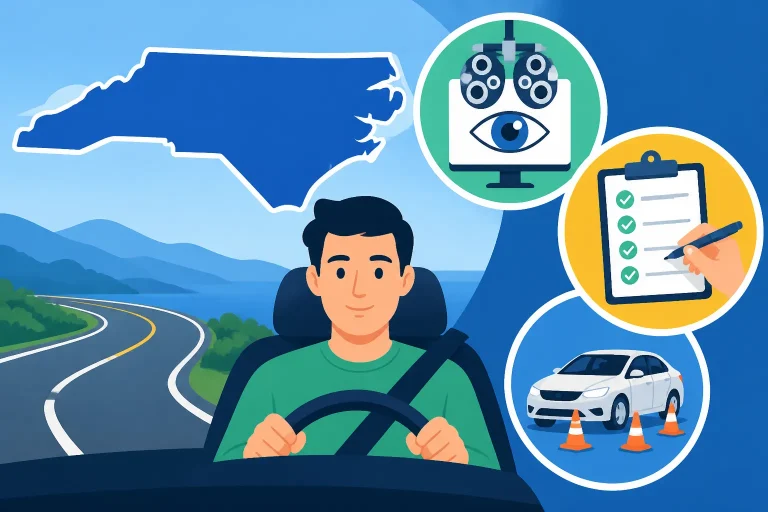
A CDL skills test generally includes three parts:
- Pre-trip vehicle inspection. You demonstrate that you can inspect key parts of the vehicle and explain what you are checking. The specific items depend on the vehicle and test.
- Basic vehicle control. You perform exercises that assess control at low speeds, such as positioning, backing, or moving through a defined space.
- Road test. You drive in traffic and demonstrate safe operation, observation, control, and compliance with traffic rules.
The test vehicle must be appropriate for the license class and any relevant endorsement. If you test in a vehicle that does not represent the class you want, you may receive a restriction or be unable to qualify for the intended credential. Check the vehicle requirements before test day, including whether the vehicle’s equipment could result in a restriction.
Prepare the test vehicle and documents
Confirm who is supplying the vehicle. If you are using an employer’s vehicle or a training provider’s vehicle, confirm the arrangement and any requirements well ahead of time. The vehicle should be legally operable and suitable for the test. A mechanical problem, missing paperwork, or mismatch between the vehicle and the requested class can derail an appointment.
Bring the documents the NCDMV requests for the test, along with your CLP and any required medical or training records. Check current check-in instructions, too. Test scheduling and location procedures can change; Where Commercial Drivers Take the CDL Skills Test in North Carolina can help you plan, but verify the latest details with the agency.
For CDL road tests, follow the NCDMV’s current booking instructions. Do not assume that the same appointment category or booking method used for a standard Class C road test applies to commercial testing. If instructions require a particular scheduling method, use that method and keep the confirmation details.
If you do not pass
A failed knowledge test or skills test does not necessarily end the process, but it can affect timing. The retest rules, waiting periods, and appointment availability may depend on the test and current NCDMV policy. Confirm those details before scheduling again.
Use the score or examiner feedback to identify what needs work. For a knowledge test, focus on the subject areas you missed. For a skills test, practice only in a legal and properly supervised setting, and ask a qualified instructor to address the specific errors. Repeating the same test without changing preparation is unlikely to be an efficient use of time.
Complete the NCDMV Application and Receive the CDL
Once you have met the applicable training and testing requirements, complete the remaining steps with the NCDMV. The exact sequence can depend on your application, so check the current agency instructions rather than relying on someone else’s timeline.
Before visiting an office
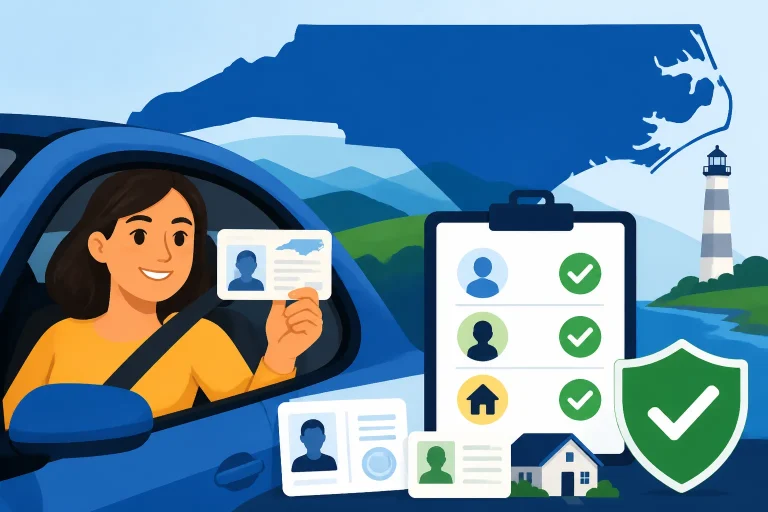
Make a checklist of what applies to your situation:
- Your current driver license and the identity documents requested
- Proof of Social Security information and North Carolina residency, if required
- Your CLP and any test-related paperwork
- Medical qualification documents, if applicable
- Proof that required ELDT was completed and recorded
- Any required endorsement or security-clearance information
- Payment method accepted by the agency
- Appointment or scheduling confirmation, if applicable
Do not bring only a digital copy when the NCDMV requires a specific original or accepted document. Check the agency’s current list, especially if you are a new resident, have a recent name change, or are applying with a non-citizen status document.
Use the correct office and appointment category
Commercial driver licensing services are handled through the NCDMV driver license system, not a vehicle license plate agency. Selecting the wrong office or appointment type can waste a trip. Before traveling, confirm the location, service category, appointment rules, and whether walk-ins are accepted for the service you need.
If you need help choosing a service category, see Selecting the Commercial Driver License Appointment Category. For the skills test, confirm the location and test-day requirements separately. Some commercial testing arrangements may have different scheduling steps from ordinary licensing appointments.
An appointment does not replace the need to bring complete documents or the right test vehicle. Arrive with enough time to check in according to the agency’s current instructions. If you are missing a required document, ask the NCDMV what is acceptable before making another trip.
Review the credential before leaving
When you receive your CDL or temporary credential, check the printed information carefully. Confirm the license class, endorsements, restrictions, and personal details. If something appears wrong or an expected endorsement is missing, ask the NCDMV how to correct it before relying on the credential for work.
A restriction can limit the vehicles you may drive. For instance, test conditions or equipment may affect whether a restriction is placed on the license. Do not assume that passing a road test means you have every permission you intended to obtain.
Understand Endorsements, Restrictions, and Ongoing Responsibilities
The CDL is not just a class printed on a card. Endorsements and restrictions define what you may operate, and ongoing qualification requirements can affect your ability to keep driving commercially.
Endorsements require planning
Review each endorsement’s requirements before applying. Passenger, school bus, and hazardous-materials permissions can involve additional testing or training. Hazardous-materials permissions also include a separate security-related process. Tank and combination endorsements have their own knowledge requirements.
If your work involves several vehicle types, ask the employer which endorsements are essential at hiring and which can be added later. An endorsement you do not need can add steps, while failing to obtain one that the work requires can make you ineligible for the assignment. For the endorsement-by-endorsement details, see North Carolina CDL Endorsements: Passenger, Tanker, and Hazmat.
Restrictions can narrow what you may drive
A CDL may carry restrictions based on the test vehicle, equipment, or qualification conditions. Examples can relate to air brakes, transmission type, or the scope of operation. The exact restriction matters: two people with the same CDL class may not have the same driving permissions.
Before accepting a driving assignment, compare the vehicle and work with the class, endorsements, and restrictions shown on your credential. If a restriction prevents you from doing the work, ask the NCDMV what testing or application steps are required to remove it. Do not drive a vehicle that falls outside your license permissions while waiting to resolve the issue.
Keep medical and licensing information current
If your CDL category requires a medical qualification, monitor its expiration and follow the current process for updating records. Letting a required medical document expire can affect CDL status. Notify the NCDMV as directed if your operating category changes or if your circumstances no longer match your self-certification.
Keep track of ordinary license renewal dates and any disqualification or suspension notices. Commercial driving can also involve employer requirements that go beyond the license itself, such as job-specific training or drug and alcohol testing. A CDL alone does not confirm that an employer has cleared you for every safety-sensitive job.
If your CDL is suspended or your privileges are otherwise limited, do not drive commercially until you understand your status and have followed the required process. Guide to License Suspensions and Restorations in North Carolina explains the broader driver-license issue; commercial consequences can involve additional rules, so verify your specific case with the NCDMV and, where appropriate, a qualified professional.
Plan the Cost, Timing, and Common Trouble Spots
There is no single total cost or timeline for every CDL applicant. Your total depends on the license class, endorsements, training provider, medical requirements, retesting, and the current agency fees. Check current figures with the NCDMV and any training provider before committing.
Build a realistic budget
Potential expenses may include:
- CDL application, permit, testing, and licensing charges
- Training tuition and required materials
- Use of a suitable vehicle for the skills test
- Medical examination, when applicable
- Additional testing or training if you do not pass the first time
- Separate endorsement or security-related steps, where required
Ask for an itemized estimate rather than comparing only a course’s advertised tuition. One provider may include vehicle use or practice hours, while another may charge separately. Also ask what happens if you need additional instruction or have to reschedule.
For branded study materials, distinguish preparation from official requirements. A study resource may help you review rules, but it does not replace NCDMV testing or required ELDT from an eligible provider. Confirm both the course content and its status before paying.
Allow for multiple steps
A smooth process still takes coordination. You may need to gather documents, pass knowledge tests, obtain a CLP, complete training, wait the required period, schedule a skills test, and finish the license application. Training availability and test appointments can affect timing, as can the need for medical records or an endorsement clearance.
Start by asking the prospective employer when the CDL is needed and which class and endorsements the position requires. Then work backward from that date. Leave room for a second test attempt or a document correction. Avoid making a job commitment based on the assumption that every step will be completed on a particular day.
Common mistakes to avoid
Choosing a class based on appearance. A large-looking vehicle does not automatically require a particular CDL class. Check the vehicle ratings and configuration.
Taking the wrong knowledge tests. Confirm which tests apply to your class and requested endorsements before arriving.
Confusing general study with required ELDT. Verify that required training is completed through an eligible provider and recorded properly.
Booking before confirming the test vehicle. The vehicle used for the skills test can affect eligibility and restrictions. Confirm it matches the class you want.
Ignoring medical self-certification. Know which operating category describes your work and what medical records must be on file.
Going to a plate agency. Commercial licensing is a driver-license service. Use the correct NCDMV location and service category.
Assuming the CDL includes every endorsement. Check the credential and make sure the permissions needed for the job are printed on it.
Waiting until the last minute. An incomplete document, failed test, or unavailable appointment can delay the start of work. Confirm each step early and keep copies of confirmations and training records.
Frequently Asked Questions
How old do you have to be to get a CDL in North Carolina?
The age requirement depends on whether the driving is intrastate or interstate. Federal rules generally require drivers to be at least 21 for interstate commercial driving. Confirm North Carolina’s current requirements and the employer’s operating area before applying.
Do I need a commercial learner permit before taking the CDL road test?
Most applicants need a CLP before taking the skills test. It allows supervised practice under restrictions and is not a full CDL. Check the NCDMV’s current rules for your class and application.
Is ELDT required for every CDL applicant?
No. ELDT applies to specified first-time CDL, upgrade, and endorsement situations, and some exemptions may apply. Confirm whether your application requires it and verify that the training provider is eligible.
Can I use a standard truck for my CDL skills test?
The test vehicle must be appropriate for the CDL class and permissions you seek. A vehicle mismatch or equipment limitation may prevent you from qualifying as intended or may result in a restriction. Confirm vehicle requirements with the NCDMV before test day.
Disclaimer
This article is for general informational purposes only and does not constitute professional advice. Laws, prices and regulations vary by location and change over time. Consult a qualified professional for guidance on your specific situation. North Carolina Driver Guide is not a government agency and is not affiliated with any state motor vehicle department.