North Carolina Driver License Renewal: Rules and Deadlines
A North Carolina license can expire before you realize a renewal needs an office visit, a vision screening, or extra documents. The best way to avoid a last-minute scramble is to check the expiration date, confirm which renewal options are available to you, and plan for any testing or identity requirements. Here’s how to prepare and what to do if your license has already expired.
Start with your expiration date and renewal window
The expiration date printed on your North Carolina driver license is the date to plan around. Don’t rely on a reminder notice to set your schedule: a notice can be delayed or missed, and receiving one does not replace the requirement to renew with the North Carolina Division of Motor Vehicles (NCDMV).
Check the date on your card and give yourself time to find out whether you’re eligible to renew online or need to visit a driver license office. An office visit may require an appointment or involve a wait, and the nearest available appointment may not line up with the date you want. If you need an in-person renewal, check the official NCDMV office locator for locations and current hours.
How early you can renew and how a renewal affects the next expiration date can depend on your circumstances. If you are considering renewing well before expiration, confirm the current rules first; renewing early may affect how much of the existing license period you use. See How Early Can You Renew Your North Carolina Driver License? for more on timing.
Your license’s length of validity can also depend on factors such as your age and license type. North Carolina uses five- and eight-year license periods in some situations, but the expiration date on your credential is the date that controls your next renewal. For details, see How Long Is an NC Driver License Valid? The 5- and 8-Year Rules.
| Situation | What to do |
|---|---|
| Your license is current and you want to renew | Check the NCDMV’s current online eligibility rules and available renewal window. |
| Your license is current but online renewal is unavailable | Plan an in-person visit and check whether you need documents, testing, or an appointment. |
| You want to add REAL ID | Confirm the document requirements and plan to visit an NCDMV driver license office if required. |
| Your license has expired | Don’t assume you can keep driving or that a grace period applies. Confirm your options with NCDMV before driving. |
| Your license is suspended or has another block | Resolve the issue through the appropriate NCDMV process before treating renewal as routine. |
Don’t treat a notice as the deadline
A mailed renewal notice can be useful, but the card’s expiration date is the safer reference point. If you have moved, changed your name, or have trouble receiving mail, make sure you understand what information NCDMV has on file and what steps are needed to update it.
Also distinguish a renewal from replacing a lost or damaged card. A duplicate credential may not extend the license’s validity. If the card is missing, unreadable, or damaged, check whether you need a replacement or a renewal rather than assuming one transaction does both.
Don’t leave the decision until the final days
A renewal may be straightforward, but added needs can change the timeline. You may need to gather identity documents, schedule a visit, complete a vision screening, or resolve an eligibility issue. Start by checking the official NCDMV requirements, then allow enough time to complete the required steps before your credential expires.
If the license expires while you are waiting, don’t assume an appointment confirmation or renewal application makes it valid for driving. Ask NCDMV what temporary document, if any, applies to your situation. Temporary driving documents have limits; Temporary Driving Certificates: Usage Rules Across North Carolina explains why one should not automatically be treated as a general-purpose photo ID.
Decide whether online or in-person renewal fits
Some drivers can renew through NCDMV’s online service, while others must renew at a driver license office. Eligibility depends on the credential and the driver’s record, as well as the current requirements of the online system. The online option is convenient when it is available, but it is not a universal substitute for an office visit.
Before beginning an online transaction, use the official NCDMV service to check your eligibility and follow its instructions. Don’t assume that a prior online renewal means you can use the online option again. North Carolina may limit how often a driver can renew online, and eligibility rules can change.
For a closer look at the online process and common restrictions, see Renewing Your North Carolina Driver License Online.
An in-person visit may be required
You may need to renew in person if you are not eligible for online renewal or if your situation requires an employee to review documents, confirm identity, or complete a screening. For example, an office visit may be necessary when you are adding REAL ID, changing information that requires proof, or dealing with a restriction or other record issue.
A credential that is not eligible for online renewal is not necessarily a problem. It simply means you should use the correct NCDMV process rather than retrying the same online transaction. Check the current instructions before arranging travel, especially if you have a commercial license, a provisional credential, an active restriction, or a significant change to your personal information.
Make the appointment for the right service
If you need an office visit, make sure you select the driver license renewal service—not a vehicle registration or license plate service. North Carolina has different service locations for driver licenses and vehicle matters. Going to a license plate agency for a driver license renewal can mean an unnecessary trip.
Appointment availability and check-in procedures can vary. Use the official NCDMV appointment system and office locator to confirm where to go, what service to select, and the current hours. If you are unsure which appointment category fits, check NCDMV’s guidance before booking. For a practical preparation list, see What to Bring to Your North Carolina DMV License Appointment.
Check eligibility before paying or submitting
An online renewal can be interrupted if the system finds an issue that requires an office visit or another action. Before starting, confirm that you have the information the official service asks for and that your current license type is eligible. If the transaction cannot proceed, read the message carefully and follow the next step NCDMV gives you.
Avoid submitting repeat transactions simply because a confirmation screen is unclear. Save any confirmation or receipt, and use NCDMV’s official customer-service channels if you need to determine whether the renewal went through. A payment confirmation by itself may not answer whether the new credential has been issued or mailed.
Prepare documents, payment, and personal information
The requirements for a routine renewal can differ from the requirements for a first license or a REAL ID application. If your name, address, or legal status has changed, or if you want to add a REAL ID designation, check the specific document rules before you go. Bringing paperwork that does not meet the requirement can delay the transaction.
For an ordinary renewal, have your current credential and any information requested by NCDMV available. If the agency’s instructions tell you to bring supporting documents, use the official checklist rather than relying on a general assumption about what counts. The documents accepted for proof of identity, Social Security number, legal presence, or North Carolina residency can depend on the situation.
The North Carolina Driver License Checklist: Identity, SSN, and Residency is useful when you need to understand those document categories. For a renewal appointment specifically, review What to Bring to Your North Carolina DMV License Appointment as well.
If you are applying for REAL ID
A renewal and a REAL ID application are related but not identical tasks. A standard North Carolina driver license can remain valid for driving without being a REAL ID. If you want the REAL ID designation, you may need to show additional documents in person, even if you are otherwise eligible to renew online.
Gather documents that satisfy the current NCDMV rules for identity, Social Security number, legal presence, and residency. If the name on one document differs from the name on another, you may need records that connect the names. Don’t assume a document was accepted in an earlier transaction or will be accepted for a REAL ID application now.
Read REAL ID Checklist and Application Rules in North Carolina before setting out. It covers the distinction between renewing an existing license and presenting the additional evidence needed for REAL ID.
If your name or address changed
A name change can require official documents showing the connection between your previous and current legal names. A marriage certificate, court document, or other record may be relevant, but the exact evidence depends on the change and NCDMV’s current requirements. Check before visiting so you can bring the complete document trail.
An address change may also need to be reported separately from renewal. Don’t assume that changing an address in one online service automatically updates every NCDMV record or appears on a replacement credential. Confirm how the agency handles your specific change.
Understand the cost before starting
NCDMV sets driver license fees, and the amount can depend on license type, term, and transaction. A third-party processing charge may apply when you use an online payment service. Because fees and payment arrangements can change, check the current amount and accepted payment methods with NCDMV before you submit payment.
If you are renewing early or renewing a credential with a different validity period, confirm how the renewal affects the next expiration date and the total charge. Don’t rely on an old receipt, a past fee, or an amount mentioned in an outdated notice.
Keep a copy of your confirmation or receipt. It can help you follow up if you need to ask about a transaction, but it does not replace the license itself or establish that you can drive after expiration.
Expect screening or testing when required
Renewal does not always mean repeating the full process used to obtain a first license. However, NCDMV may require screening or testing based on your age, driving record, license type, restrictions, or other circumstances. The agency determines which requirements apply to your renewal.
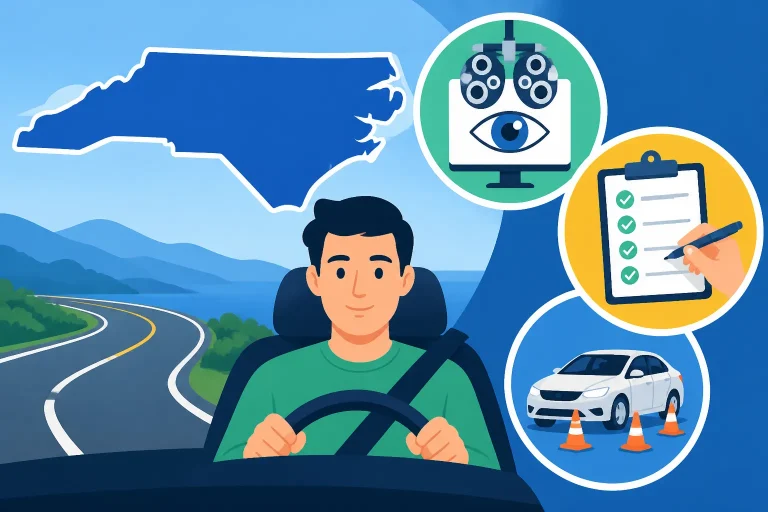
A vision screening is a common part of an in-person renewal. If your vision needs correction to meet the standard, NCDMV may issue or retain a corrective-lenses restriction. Bring the glasses or contact lenses you use for driving, and wear them during the screening if you rely on them. For more detail, see NC License Renewal Vision Test Requirements.
Vision screening and corrective-lens restrictions
The screening checks whether you meet the applicable vision standard for driving. If you have a known vision condition, recent changes in eyesight, or difficulty seeing clearly, address that before your appointment rather than hoping the screening will be waived. If the result raises a question, NCDMV may direct you to provide additional information or take another step.
A restriction on your credential matters. If your license requires corrective lenses, you must follow that restriction when driving. Renewing the license does not automatically remove a restriction. Ask NCDMV what evidence is needed if you believe the restriction should change.
Knowledge, road, or other testing
A routine renewal is not necessarily a new road test, but it is also not safe to assume that no test can ever be required. NCDMV may require testing in certain cases, including when a record, restriction, or other circumstance calls for it. Commercial drivers may have requirements that differ from those for a standard Class C license.
If you have been told to take a test, confirm which one, where it is administered, and whether you need a separate appointment. Preparing for the wrong test or selecting the wrong service can cost time. Tests Required to Renew Your NC Driver License explains the kinds of testing that may come up during renewal.
Medical or driving-record concerns
If a medical condition could affect safe driving, NCDMV may request information or impose a restriction. Answer agency questions accurately and ask what documentation is required. A medical review is not the same thing as a routine vision screening, and the steps depend on the facts of the case.
A suspension, revocation, or other block can also affect renewal. In that situation, the primary task may be to resolve the driving-privilege issue, not to submit a standard renewal. Check your status and follow the instructions from NCDMV. If you are dealing with a suspension or restoration, start with Guide to License Suspensions and Restorations in North Carolina.
Complete the renewal and protect yourself while the new card arrives
Whether you renew online or in person, follow the instructions from NCDMV and keep the confirmation information until you receive and check the new credential. Review the card when it arrives: make sure your name, address, license class, restrictions, and expiration date are correct. If something is wrong, contact NCDMV promptly for directions rather than waiting until the next renewal.
Online renewal
Use only the official NCDMV service to check eligibility and complete an online renewal. Review every field before submitting. Confirm that your mailing address is current and that you can receive mail there; a correct transaction can still become a problem if the new card goes to an outdated address.
Save the transaction confirmation and any payment receipt. If you do not receive a card when expected, check NCDMV’s official guidance for delivery follow-up. Do not assume that an online confirmation is a temporary license, a photo ID, or proof that every restriction has been cleared.
If the online service says you are not eligible, don’t try to bypass the restriction by selecting a different transaction. Follow the instructions for an in-person visit or contact NCDMV through its official channels to understand what is blocking renewal.
In-person renewal
Before leaving for the office, check the official locator for the correct driver license location and its current hours. Bring the items NCDMV has instructed you to provide, including any supporting records and payment method accepted for your transaction. Allow time for intake, document review, screening, and the service itself.
If you need language assistance or an accommodation, check NCDMV’s process in advance. If you are taking a test, confirm that your appointment is for the right type of service and arrive according to the instructions. A renewal appointment may take longer when testing or additional document review is involved.
At the end of the visit, ask what temporary document you have received, if any, and what it permits you to do. Temporary driving certificates are intended for specific purposes and may not function as photo identification. See Temporary Driving Certificates: Usage Rules Across North Carolina for the distinction.
When the license has expired
If your license is already expired, don’t rely on an assumed grace period. Confirm with NCDMV whether you can renew and whether testing, documents, or another action is required. Until you have confirmed that you are authorized to drive, do not treat an appointment booking, online application, or payment receipt as permission to drive.
A late renewal may be possible under certain conditions, but eligibility and any testing requirements depend on the circumstances and the current rules. Check the official renewal instructions before traveling. If your record shows a suspension or another block, resolve that issue through the appropriate process rather than trying to renew around it.
If the license has been expired for a while, ask NCDMV specifically whether the normal renewal route still applies. The answer can depend on how long it has been expired, the license type, and your driving record. Avoid relying on advice from someone with a different license type or a different situation.
If your new card has not arrived
Keep your old card, any temporary document, and your transaction confirmation together while you wait. Follow the instructions NCDMV gives you about the status of the new credential. If the expected delivery period has passed, use the official agency’s guidance to ask about the card rather than submitting a duplicate request immediately.
A replacement request can create confusion if the original renewal is still being processed. First determine whether the credential was issued, mailed, returned, or delayed. If a temporary document was provided, check its expiration and permitted use; do not assume it extends indefinitely.
Common renewal problems and how to avoid them
Many renewal delays come from a mismatch between the service selected and the task the driver actually needs. A name change, REAL ID upgrade, replacement credential, suspension, or commercial license requirement may call for a different process from a routine renewal. Identify the issue before you start, then follow the NCDMV instructions for that specific transaction.
The online system says you are ineligible
An online denial or stop message usually means there is a requirement the system cannot complete through that channel. Read the message carefully and note any directions. You may need an office visit, a document review, or a separate action on your record.
Don’t repeatedly submit the same transaction or choose a different option just to get around the message. If the reason is unclear, contact NCDMV through its official customer-service channels. Have your license information and any error or confirmation details available when you ask.
You want to renew and upgrade to REAL ID
Treat the REAL ID upgrade as a document-heavy part of the visit, not as a simple change to the card design. Check the current requirements and bring the original or otherwise accepted records NCDMV specifies. If your name has changed more than once, make sure your documents show an unbroken link between the names.
If you do not have the required REAL ID documents, you may still be able to renew a standard license, depending on your eligibility. Confirm the options with NCDMV rather than delaying a needed renewal solely because you are not ready to apply for REAL ID.
Your record has a block or restriction
A renewal transaction may not resolve a suspension, unpaid obligation, testing requirement, or medical review. First find out what the record issue is and which agency process applies. Then follow that process and check whether any separate renewal step remains afterward.
If you are unsure whether your driving privilege is valid, do not rely on an old license card as proof that it is currently active. The physical card can show an expiration date, but it may not display a later suspension or other status change. Use the official NCDMV process to confirm your status.
You need a different credential
A state identification card, learner permit, provisional license, commercial license, and standard driver license do not all follow the same renewal rules. Make sure the credential you hold matches the service you intend to use. If you are changing license class or endorsements, ask what additional tests or documents apply.
A renewal is also different from transferring an out-of-state license to North Carolina. New residents should follow the transfer rules rather than treating their first North Carolina credential as a renewal. Drivers who need a non-driver ID can review Guide to North Carolina State Identification Cards.
Frequently Asked Questions
Can I drive while my North Carolina license renewal is pending?
Do not assume that a pending renewal, payment receipt, or appointment confirmation authorizes you to drive. Check what document NCDMV has issued and what it permits. If your license has expired and you are unsure of your status, confirm with NCDMV before driving.
Is an in-person visit required for every renewal?
No. Some drivers may be eligible to renew online, but online access depends on current NCDMV rules and the details of the credential and record. If the system directs you to an office, follow that instruction.
Does renewing my standard license automatically make it REAL ID?
No. REAL ID has separate requirements. If you want to add the designation, check the current document checklist and whether an in-person visit is required.
Will I have to take a vision or road test?
A vision screening or another test may be required depending on your circumstances. A routine renewal does not automatically mean a road test, but NCDMV can require testing when applicable. Check your renewal instructions and any notice from the agency.
What should I do if my license is already expired?
Confirm your renewal options and driving status with NCDMV before driving. The appropriate steps can depend on how long the credential has been expired, the license type, and whether your record has a block or other requirement.
Disclaimer
This article is for general informational purposes only and does not constitute professional advice. Laws, prices and regulations vary by location and change over time. Consult a qualified professional for guidance on your specific situation. North Carolina Driver Guide is not a government agency and is not affiliated with any state motor vehicle department.